
Cognitive Dissonance

This is a situation where an individual feels mental discomfort due to contradictory beliefs, attitudes or behaviours which results in a change of beliefs or attitudes to harmonise this friction[1].  Individuals are motivated to calm this dissonance by changing their behaviour, attitudes or actions.  This involves a strong form of confirmation bias[2], which allows the individual to filter any non-conforming information or evidence, when increased dissonance is experienced.

This is commonly seen in cults. Friction between cult beliefs and reality causes cognitive dissonance amongst members of the cult.  Members filter non-conforming information to the extent that they stop associating with anyone carrying a contradictory belief.  They cut off family and friends from the social circle and fill it with individuals who share the same beliefs.  This creates an echo chamber within an epistemic network, which reinforces their belief, calming their cognitive dissonance.  A milder variation of this can be seen through society with such conspiracy as Covid-19 or 5G[3].

Humans desire for consistency and habit are directly rooted in our demand for less cognitive load, a ‘laziness’ which pushes us to use heuristics, which can push us to change habits, behaviours and actions, to decrease the load that cognitive dissonance places on our amygdala.


[1] Festinger, L. 1919-1989. (1962) A theory of cognitive dissonance / Leon Festinger. Stanford University Press. Available at: https://research.ebsco.com/linkprocessor/plink?id=9a1ee125-ca54-3298-a920-ea3cb9caf99e (Accessed: 7 May 2024).

[2] Confirmation bias refers to a tendency to search for, interpret, favour, and recall information that supports existing beliefs, while ignoring any contradictory evidence or information.
[3] https://www.ncbi.nlm.nih.gov/pmc/articles/PMC8576388/

Mental Accounting

Mental Accounting postulates that individuals focus on independent economic buckets instead of the overall economic outcome[1].   This is built upon the foundations of the framing effect in prospect theory, where an opinion is formed based on how the information is provided, a positive opinion correlates to positive information and vice versa.

This can be seen where individuals are more likely to spend their bonus as it is framed as a reward for hard work as opposed to their normal wage, which is framed as money for expenses.

Traders often take more risk when they are winning as opposed to when they are losing, the house money effect[2].  This is an inherent view that when they have more, they can bet more, however circumstances often change after a winning run and if bet sizes are larger than normal then losses would be larger than normal, a better strategy would be to bet consistently, providing that one has an edge.


[1] Thaler, R.H. (1999) ‘Mental Accounting Matters’, Journal of Behavioral Decision Making, 12(3), pp. 183–206. doi:10.1002/(SICI)1099-0771(199909)12:3<183::AID-BDM318>3.0.CO;2-F.

[2] Where individuals take greater risks with money they perceive as “gains” or “house money” than they would with their original investment, savings, or baseline wealth.

Familiarity Bias

The foundation of the familiarity heuristic is an offshoot of the availability heuristic[1], whereby individuals employ a judgemental heuristic where individuals estimate probability distributions using the most readily available information, leading to systematic biases.  This grows into the familiarity bias, where familiarity is favoured as it is perceived to carry less risk, over the unusual.  It takes less cognitive energy to filter non-conforming information, which can trigger cognitive dissonance[2] than to process it. 

A feature of this heuristic in finance is the home market bias, where investors prefer the comfort of investing in their own local market as opposed to foreign ones, so the ASX[3] for Australians.  Having a home market bias does introduce some issues into investor portfolios, especially in Australia, where there is a high percentage sector weight to Finance and Materials in our index and minimal weight to Technology and Health, which lessens the power of diversification within the portfolio[4].

Over the years, the barriers to investing offshore have decreased as online services[5]have proliferated and its now cheap and easy for investors to add offshore diversification to their portfolios.  One way of encouraging clients to step out of their f familiarity zone is to add holdings slowly and with minimal weights to start if they are attempting direct investments.  From an asset allocation perspective, the same can apply, begin with a smaller weight to get clients comfortable with the new experience, before increasing the weights as they get more comfortable with the experience.


[1] Tversky, Amos; Kahneman, Daniel (1973). “Availability: A heuristic for judging frequency and probability”. Cognitive Psychology. 5 (2): 207–232. doi:10.1016/0010-0285(73)90033-9. ISSN 0010-0285.

[2] Refer to Cognitve Dissonance.

[3] Australian Stock Exchange.

[4] https://www.vanguard.com.au/personal/learn/smart-investing/investing-strategy/home-equities-bias

[5] eToro, IG, Superhero, CMC Markets, Stake etc

Recency Bias

Recency bias is the tendency for individuals to recall and emphasise the most recent events as opposed to those in the past.  Furthermore, if the event has not been experienced, individuals will tend to ignore the event.  This was promulgated on the serial position effect[1], which is the tendency to recall the first and last event in a series and forget the middle.  It’s a natural heuristic process as it requires less energy and time to remember two nodes and infer the path. 

Investors naturally extrapolate current events into the future, in a linear regression fashion, conveniently forgetting that market events move in a sinusoidal manner.  This results in investors being overweight growth at the end of bull markets and panic selling at the end of bear markets.

To counter this bias, we need to educate the investor that history moves in waves, and the most damage done to an investor portfolio is self-inflicted.  Tackling recency bias is important, in the advice sequence as once investors are overweight growth during a downturn, loss aversion[1] and panic set in, and managing client expectations in that scenario becomes extremely difficult.


[1] Refer Prospect Theory.


[1] Ebbinghaus, Hermann (1913). On memory: A contribution to experimental psychology. New York: Teachers College.

Dunning–Kruger Effect

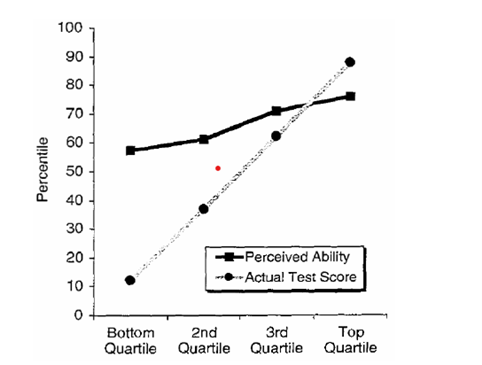
This is the effect that individuals overestimate their ability and skills in many domains[1].  They suffer from a lack of competence, cognitive skills and a lack of self-assessment capability.  This is seen in students’ estimation of their ability and test scores as seen in the figure below[2].  Those in the bottom quartile of skill and ability perceive their ability to be much higher than their actual test scores as opposed to the top quartile where the actual test score is higher than their perceived ability or knowledge. 

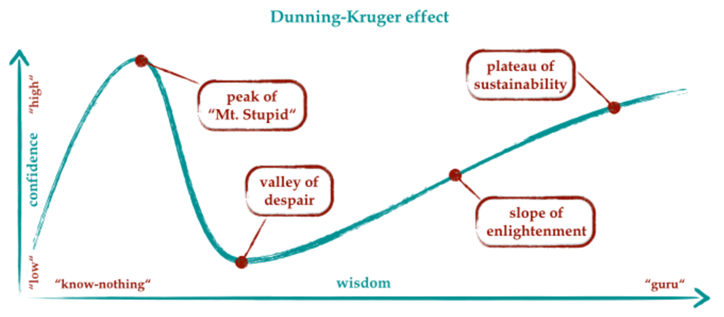
The graph below[3] shows a good depiction of the cognitive bias that most individuals suffer on their road to knowledge and mastery.

On the journey toward being a professional trader, the older ones realise how little they know and how much more work lies ahead. Most novice traders are too confident of their abilities, bet too big and generally don’t survive their initial year.

“The more you know, the more you realize you don’t know.”[4]


[1] Kruger, Justin; Dunning, David (1999). “Unskilled and Unaware of It: How Difficulties in Recognizing One’s Own Incompetence Lead to Inflated Self-Assessments”. Journal of Personality and Social Psychology. 77 (6): 1121–1134. CiteSeerX 10.1.1.64.2655. doi:10.1037/0022-3514.77.6.1121. PMID 10626367. S2CID 2109278.

[2] Ibid pp 1124

[3] https://ardalis.com/the-more-you-know-the-more-you-realize-you-dont-know/

[4] Aristotle

The Disposition Effect

The disposition effect is when investors sell winners too early and hang onto loser for too long[2]. This is a manifestation of the Allais paradox[1], which showed an inconsistency between the theory of expected utility and the sub-optimal and often irrational choices that individuals make. Its foundations are built upon several theories.  One such is prospect theory, where investors fear losses more than they cherish gains, hence individuals would delay the realisation of losses.  Another is seeking pride and avoiding regret, where a realisation of the loss would be proof that their judgement was flawed and not taking the loss would avoid regret. 

This can be seen in the behaviour of investors, where they are twice as likely to sell a winning stock than a losing stock[3].  The average investor would have a greater ratio of average unrealised losses than the average ratio of realised gains. 

Using traders as an example, the first cohort of traders who don’t survive are those who cannot realise their losses quickly and/or hang onto their gains.  They lack discipline and are plagued with the disposition effect.


[1] Allais, Maurice (1979). Allais, Maurice; Hagen, Ole (eds.). Expected Utility Hypotheses and the Allais Paradox. D. Reidel Publishing Company. doi:10.1007/978-94-015-7629-1. ISBN 978-90-481-8354-8.

[2] Shefrin, H. and Statman, M. (1985) ‘The Disposition to Sell Winners Too Early and Ride Losers Too Long: Theory and Evidence’, Journal of Finance (Wiley-Blackwell), 40(3), pp. 777–790. doi:10.1111/j.1540-6261.1985.tb05002.x.

[3] Barber, B.M. et al. (2007) ‘Is the Aggregate Investor Reluctant to Realise Losses? Evidence from Taiwan’, European Financial Management, 13(3), pp. 423–447. doi:10.1111/j.1468-036X.2007.00367.x

Prospect Theory

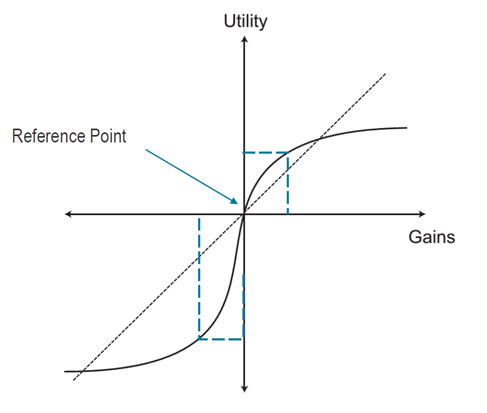
Prospect theory[1], developed by Kahneman and Tversky, observed the asymmetric value felt by individuals in losses over gains as seen in figure below. This contradicts the premise that individuals are utility-maximising agents, which if true, the value function would be a linear 45° line.

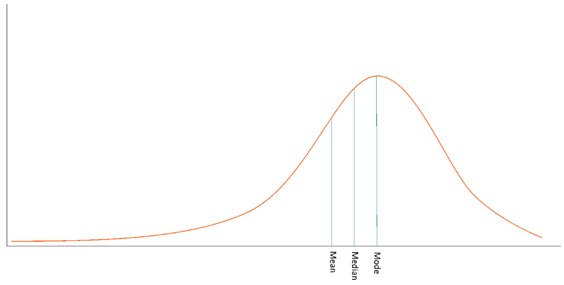
This is best seen in the distribution function of stock market returns as seen below in the figure below, which has kurtosis and a fatter left tail.  If humans were profit-maximizing agents, the distribution would be more normal, however as individuals feel loss twice as powerfully as they feel gains, the losses are magnified by panic selling when the markets are falling.


[1] Kahneman, D. and Tversky, A. (1979) ‘Prospect Theory: An Analysis of Decision under Risk’, Econom etrica, 47(2), pp. 263–291. doi:10.2307/1914185.

Traditional Finance vs Behavioural Finance

Traditional finance or classic economics, portrays a person as a rational, self-interested individual who can maximise their utility, with full agency and information, able to discern the best course of action amongst their choices.  In essence, a perfectly rational human being.

This has evolved to the current bastion neoclassical thought exemplified by the Chicago School[1], which is heavily influenced by rational expectations theory[2]. A classic example is Fama’s Efficient market Hypothesis[3], which postulates in securities markets prices are perfectly efficient and reflect all available information. This is predicated upon the assumption that individuals are always maximising their expected utility when making decisions.

Traditional finance took a one-dimensional approach, considering man as an island, when constructing their theories for the sake of convenience.

“Behavioral Economics is the combination of psychology and economics that investigates what happens in markets in which some of the agents display human limitations and complications.”[4]

As the economic profession developed, new theories were developed to supplement the one-dimensional assumption that individuals are pure utility maximizing agents.  Many studies have shown that individuals are more likely to consider sub-optimal economic outcomes stemming from behavioural biases or risk mitigation purposes.  Thus, the field of behavioural finance was developed to understand the human decision-making process in practice as opposed to a simplified theoretical version expounded by classical economics.

Behavioural finance is a multi-dimensional approach to analysing the true reaction function of agents on a macro and micro economic level in a better approximation of reality.

The best example between traditional finance and behavioural finance is the Ultimatum game. This is where one player is given a sum of money and proposes a split with the second player, the second player can accept the split or reject the split, if the second player rejects the split, then none of the players get anything, if the second players accept, both part ways with the split determined by the first player.  Offers less than 30% to the second player are rejected 50% of the time[5]

A utility maximising individual should have chosen any outcome as their base case was nothing and any split is something.  Results show that other issues come to fore, such as personal equity, when humans make decisions.  While traditional finance does provide a simple guide to understanding human behaviour, it is too simplistic a model.  Behavioural finance is a burgeoning field which seeks to better understand our decision matrix.


[1] University of Chicago

[2] John F. Muth (1961) “Rational Expectations and the Theory of Price Movements” reprinted in the new classical macroeconomics. Volume 1. (1992): 3–23 (International Library of Critical Writings in Economics, vol. 19. Aldershot, UK: Elgar.)

[3] Fama, Eugene F. “Efficient Capital Markets: A Review of Theory and Empirical Work.” The Journal of Finance 25, no. 2 (1970): 383–417. https://doi.org/10.2307/2325486.

[4] Mullainathan, Sendhil and Thaler, Richard H., Behavioral Economics (September 2000). Available at SSRN: https://ssrn.com/abstract=245828 or http://dx.doi.org/10.2139/ssrn.245828

[5] Güth, Werner; Schmittberger, Rolf; Schwarze, Bernd (1982). “An experimental analysis of ultimatum bargaining” (PDF). Journal of Economic Behavior & Organization. 3 (4): 367–388. doi:10.1016/0167-2681(82)90011-7

Ecclesiastes 9:11

I have seen something else under the sun: The race is not to the swift or the battle to the strong, nor does food come to the wise or wealth to the brilliant or favor to the learned; but time and chance happen to them all.

Why Nations Fail

The authors argue that the recipe for success as a nation requires inclusive institutions.  We see this starting in 17th century England, where the Glorious Revolution limited the power of the monarchy and transferred power to parliament to create and maintain inclusive institutions.  

They argue that monarchy or the elites will naturally favour extractive institutions and impede any innovation and/or technological change that has the potential to change the status quo and potentially reduce their grip on power.  Extractive institutions engender a repressive cycle whereby the greater the degree of extraction, the less incentive is there to be productive and the less one is willing to embrace innovation.  If the elite is going to take away 90% of what you produce, why bother making more?

The more power that is concentrated, the more vicious the leader must be to hold onto to power.  Many will see that as the easiest way to get ahead.  Some start off as altruistic but without any push toward creating more inclusive institutions you either have the best case of the ‘middle income trap’ or worse case – a despot. – Animal Farm syndrome.

On the productivity spectrum – slavery vs enjoying 100% fruits of your labour (embrace innovation and technological change to maximise labour output)

Elites come in many forms – not only a ruling class but an economic monopoly is also an extractive institution. 

The Western world has a higher level of living standard is essentially the rule of law, excellent property rights, equitable and easily understood laws that protect you and your property to ensure that any fruits of your labour can be enjoyed without the fear of appropriation.

Countries get stuck in the middle-income trap due to political institutions being extractive but allowing growth from a low base (as it suits them to extract from a bigger pie if it does not threaten the elites grip on power) but still being extractive favouring the ruling elite.  One of the hallmarks of middle-income countries is the control of media as opposed to developed countries where media rights are sacrosanct.

Growth under extractive institutions will eventually hit a wall as one of the conditions of innovation is the creative destruction of the ‘status quo’ and by extension, a corrosion of the elite’s hold on power.  Absolute power corrupts absolutely, and we can extrapolate that down, hence a true democracy has checks and balances on the elites.

Authoritarian growth looks great as they usually start off from having nothing and importing technology and allowing growth under the auspices of an extractive framework – cheap labour with controlled mobility.  An example is the USSR’s phenomenal growth rate in the 50-60s before hitting a wall in the 70-80’s because there was no change in the institutions that allowed creative destruction, there was no cycle of renewal, ones that would foster technological advancement and reward innovation.

Modernization theory by Seymour Martin Lipset: All societies as they grow will head towards a civilised democracy, an educated workforce will naturally lead to democracy and more inclusiveness.  There are many highly educated people with extractive elites and controlled media.  Perhaps it’s a matter of time but the elites will not give up power without a fight, which has never been the way that history has operated.

China will eventually hit the middle-income trap without allowing true Schumpeterian creative destruction which is required for true innovation to arise.  Can ‘controlled’ creative destruction can be achieved?

Summary of Why Nations Fail: The Origins of Power, Prosperity, and Poverty by Daron Acemoglu, J., Robinson, J. (2012)