

It is not the critic who counts; not the man who points out how the strong man stumbles, or where the doer of deeds could have done them better. The credit belongs to the man who is actually in the arena, whose face is marred by dust and sweat and blood; who strives valiantly; who errs, who comes short again and again, because there is no effort without error and shortcoming; but who does actually strive to do the deeds; who knows great enthusiasms, the great devotions; who spends himself in a worthy cause; who at the best knows in the end the triumph of high achievement, and who at the worst, if he fails, at least fails while daring greatly, so that his place shall never be with those cold and timid souls who neither know victory nor defeat. – Theodore Roosevelt
RBA Between Scylla and Charybdis
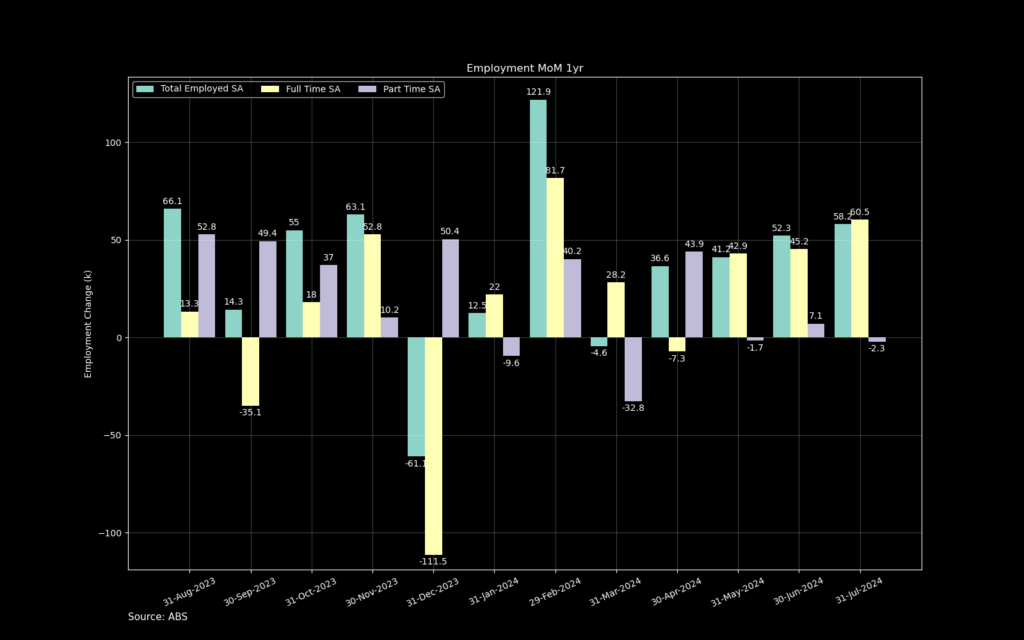
Increased participation rate, strong 3 months rolling full-time employment with inflation sticky in the mid-3s against some anecdotal consumer weakness. Might take a little more time for conditions to soften.
10 Stages of Genocide
- Classification.
‘Us & them” categorization
- Symbolization.
Swastikas, Yellow Star
- Discrimination.
Deny rights to other groups.
- Dehumanization.
Equate other groups with vermin, diseases or insects.
- Organisation.
By State, militia or paramilitary force.
- Polarisation.
Propaganda that promotes extremism. Laws forbidding intermarriage or social interaction.
- Preparation.
Final solution paradigm.
- Persecution.
Identified and separated.
- Extermination.
Mass Killings aka genocide.
- Denial.
Deny that the crime has been committed. Destroy the evidence. Obfuscate the truth.
Dr Gregory H. Stanton Genocide Watch.
Herman Göring on War
During the Nuremberg Trails, Gustave Gilbert, an American psychologist told Herman Göring that the average person did not want to be dragged into war, Göring’s response was “Why, of course, the people don’t want war. Why would some poor slob on a farm want to risk his life in a war when the best that he can get out of it is to come back to the farm in one piece? … It is always a simple matter to drag the people along .. All you have to do is tell them they are being attacked and denounce the pacifists for lack of patriotism and exposing the country to greater danger”
Excerpt from Sinai, J. (2022) Walter Barbara F. How Civil Wars Start – and How to Stop Them.
“Those who can make you believe in absurdities can make you commit atrocities”
-Voltaire
Notes on the book in the link below:
https://bambootrading.com.au/wp-content/uploads/2024/07/How-Civil-War-Starts-Barbara-Walters.pdf
Dimension of Populism
A Martial Arts Story
A martial arts student went to his teacher and said earnestly, “I am devoted to studying your system. How long will it take to master it? The teacher replied casually, “Ten Years”.
Impatiently, the student answered, “But I want to master it faster. I will work hard. I will practice every day, ten or more hours a day if I have to. How long will it take then?”
The teacher thought for a moment and said ‘Twenty Years”
Expectation vs Agreement
Great audio by Steve Chandler, please see below for his Linkedin profile and the mp3.
In attempting to translate one’s expectation into an agreement, it gives the expectation a reality test. If the expectation can be accommodated or translatable into reality, it is feasible. If the expectation cannot transition to reality, it requires modification or elimination. Depending on the person and expectation, the modification or deletion could be a herculean effort. However, changing their environment/reality to accommodate their expectation, could also be a herculean effort or an impossibility. Cognitive dissonance will remain if both are left unsettled. Depending on the situation, from an energy/resource/effort perspective, it is often always easier to change or eliminate one’s expectations.
Default Mode Network
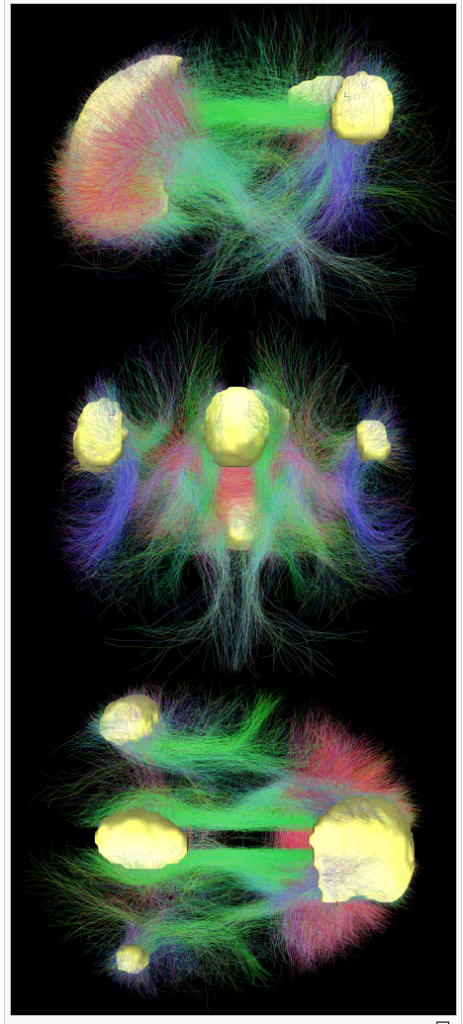
“In neuroscience, the default mode network (DMN), also known as the default network, default state network, or anatomically the medial frontoparietal network (M-FPN), is a large-scale brain network primarily composed of the dorsal medial prefrontal cortex, posterior cingulate cortex, precuneus and angular gyrus. It is best known for being active when a person is not focused on the outside world and the brain is at wakeful rest, such as during daydreaming and mind-wandering. It can also be active during detailed thoughts related to external task performance. Other times that the DMN is active include when the individual is thinking about others, thinking about themselves, remembering the past, and planning for the future.”
Source: https://en.wikipedia.org/wiki/Default_mode_network
Below is an image of the brain that is active when in DMN. When I meditate in the mornings, I do feel a sensation at the back of the head when it is active. It’s fascinating that you can feel it firing during ‘wakeful rest’.
The Hooked Model
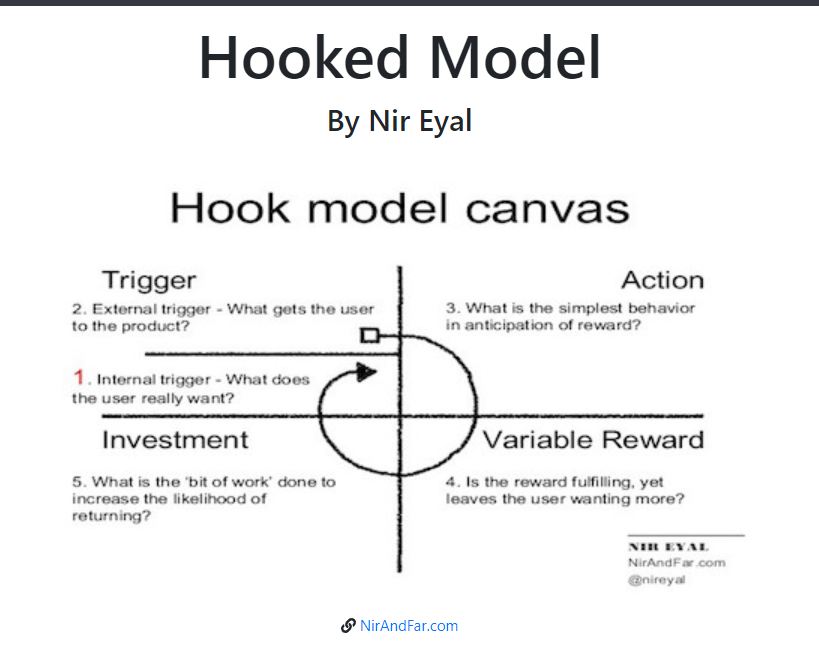
- Rather than using conventional feedback loops, companies today are employing a new, stronger habit-forming mechanism to hook users—the Hooked Model.
- At the heart of the Hooked Model is a variable schedule of rewards: a powerful hack that focuses attention, provides pleasure, and infatuates the mind.
- Our search for variable rewards is about an endless desire for three types of rewards: those of the tribe, the hunt and the self.
Source: https://www.nirandfar.com/want-to-hook-your-users-drive-them-crazy/
It is a fascinating tool to augment commitment devices in a decision-making framework.
Illusion of Control
Illusion of control is where an individual feels that they can control an outcome in their environment[1], which leads to overconfidence (Phase 1 in the Dunning Krueger Effect[2]). For investors, this leads to high degrees of portfolio concentration, increased trading frequency and more leverage.
The illusion of control is prevalent amongst traders, especially novice traders who believe that whatever simplistic process works ad infinitum. If they survive and develop some tenor in the profession, they tend to use multiple heuristics or develop a more systematic approach, which can be fully autonomous.
As traders develop along the Dunning Krueger Curve, those who survive recognise that there is no control over the situation except their personal reaction function.
Restrictions on bet size/individual weightings, stop loss exits or concentration limits or other such risk management strategies can limit the worst of it, as they hard code risk management into the process but the frequency of trading is only ameliorated through time and pain. A greater appreciation of randomness comes with age.
Not being religious, it’s ironic that one of my favourite quotes comes from the Bible:
“I returned, and saw under the sun, that the race is not to the swift, nor the battle to the strong, neither yet bread to the wise, nor yet riches to men of understanding, nor yet favour to men of skill; but time and chance happened to them all.”[3]
[1] Langer, E. J. (1975). The illusion of control. Journal of Personality and Social Psychology, 32(2), 311-328.
[2] Please refer to Dunning Krueger Effect.
[3] Ecclesiastes 9.11, Holy Bible. King James Version.